Disclaimer: This section of our website was developed to assist businesses conducting paint stripping and surface coating operations. The information provided here is intended only as a guide and may not be complete. Businesses that may be subject to this rule should refer to the federal rule, 40 CFR Part 63, Subpart HHHHHH. A brochure about this rule is also available from the USEPA.
On January 9, 2008, the Environmental Protection Agency (EPA) published the final rule for 40 CFR Part 63, Subpart HHHHHH National Emissions Standards for Hazardous Air Pollutants (NESHAP):
New sources must comply with this rule immediately upon startup. Existing sources must be in compliance by January 10, 2011. This standard is adopted by reference in the Forsyth County Air Quality Technical Code (Section 3D .1111).
This rule requires you to submit an Initial Notification and Notification of Compliance Status, use certain Management Practices including operator training, and keep records. You may also have to submit an Annual Notification of Changes Report.
Initial Notification:
New sources must notify the USEPA and this Department that they are subject to this rule by 180 days after operations begin. Existing sources must notify the USEPA and this Department by January 11, 2010. An Initial Notification form can be found in the Paint Stripping & Miscellaneous Surface Coating Operations Section of our forms page.
Notification of Compliance Status:
New Sources must submit this along with the Initial Notification. Existing sources are required to submit this notification only if the initial notification did not certify that your source is already in compliance with this rule. This notification must be submitted to the USEPA and this Department by March 11, 2011. A Notification of Compliance Status form can be found in the Paint Stripping & Miscellaneous Surface Coating Operations Section of our forms page.
Record Keeping:
You are required to keep records and submit annual reports. Records must be kept for five years and records for the most recent 2 years must be kept on site. The specific records you are required to keep are listed in the federal rule § 63.11177 What records must I keep?
Annual Notification of Changes Report:
You are required to submit an Annual Notification of Changes Report before March 1st of each calendar year if there has been a change to any information previously reported or if there have been any deviations from your management practices. More information about when you must submit this report and what to include can be found in the federal rule § 63.11176 What reports must I submit?
| New Sources | Existing Sources | |
|---|---|---|
| Initial Notification | July 7, 2008 or 180 days after startup, whichever is later | January 11, 2010 |
| Compliance with Rule | Immediately | January 10, 2011 |
| Notification of Compliance | Included with Initial Notification | March 11, 2011 |
| MeCl Minimization Plan Review and Update | Annually before March 1 to report any changes or deviations | Annually before March 1 to report any changes or deviations |
| Annnual Reporting | March 1 each year if changes or deviations occurred | March 1 each year if changes or deviations occurred |
For assistance please contact Steven Lyda by email or by calling (336) 703-2444.
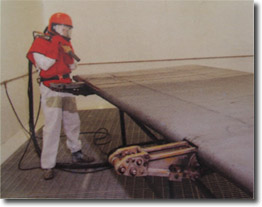 This
rule applies to your facility if you use chemical strippers that contain methylene
chloride (MeCl) to remove dried paint (including, but not limited to, paint, enamel,
varnish, shellac, and lacquer) from wood, metal, plastic, and other substrates.
This rule does not apply to your facility if you do not use strippers that contain
MeCl. This rule also does not apply to paint stripping performed by individuals
on their personal vehicles, possessions, or property, either as a hobby or for maintenance
or if done for others without compensation.
This
rule applies to your facility if you use chemical strippers that contain methylene
chloride (MeCl) to remove dried paint (including, but not limited to, paint, enamel,
varnish, shellac, and lacquer) from wood, metal, plastic, and other substrates.
This rule does not apply to your facility if you do not use strippers that contain
MeCl. This rule also does not apply to paint stripping performed by individuals
on their personal vehicles, possessions, or property, either as a hobby or for maintenance
or if done for others without compensation.
How Do I Comply?
You must complete and submit an Initial Notification Form and Notification of Compliance Status Form to the USEPA and this Department. You must also follow management practices outlined below.
Management Practices:
Paint stripping operations that use less than one ton of MeCl annually must implement “Best Management Practices” to minimize evaporative emissions of MeCl. At a minimum you must:
- Evaluate each application to ensure there is a need for paint stripping;
- Evaluate each application using MeCl to ensure there is no alternative technology that can be used. Alternative technologies include: using paint strippers without MeCl, mechanical stripping, blasting, or thermal and cryogenic decomposition;
- Reduce exposure of paint strippers containing MeCl to the air;
- Optimize application conditions to reduce evaporation (e.g., maintaining low temperatures to reduce evaporation when the stripper is heated); and
- Practice proper storage and disposal of paint strippers (e.g., store in closed, air-tight containers).
Paint stripping operations that use more than one ton of MeCl annually must:
- Develop and implement a written MeCl Minimization Plan to minimize the use and emissions of MeCl. The plan must address the five management practices listed above;
- Post a placard or sign outlining the MeCl minimization plan in each area where paint stripping using MeCl occurs;
- Maintain a copy of the current MeCl Minimization Plan on site at all times; and
- Review the plan every year and evaluate new methods of stripping, and keep records of the review and changes made to the plan.
Additional compliance assistance tools are available at EPA's Collision Repair Campaign website. Be sure to check out the training video starring former NASCAR driver Jeff Gordon.
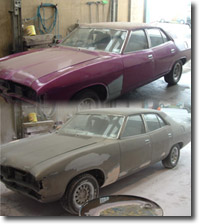 This
rule applies to all motor vehicle and mobile equipment surface coating operations
including small auto body refinishing shops. If you can demonstrate that you spray
apply only coatings that do not contain compounds of chromium (Cr), lead (Pb), manganese
(Mn), nickel (Ni), or cadmium (Cd) at levels above the thresholds listed in the
federal rule, you may petition this Department and the USEPA Administrator for an
exemption from this subpart. The petition for exemption is included in the
Paint Stripping & Miscellaneous Surface Coating Operations Section of
our forms page. This rule does not apply to:
This
rule applies to all motor vehicle and mobile equipment surface coating operations
including small auto body refinishing shops. If you can demonstrate that you spray
apply only coatings that do not contain compounds of chromium (Cr), lead (Pb), manganese
(Mn), nickel (Ni), or cadmium (Cd) at levels above the thresholds listed in the
federal rule, you may petition this Department and the USEPA Administrator for an
exemption from this subpart. The petition for exemption is included in the
Paint Stripping & Miscellaneous Surface Coating Operations Section of
our forms page. This rule does not apply to:
- Surface coating performed by individuals on their personal vehicles either as a hobby or for maintenance or if done for others without compensation.
- Facility maintenance. Facility maintenance does not include surface coating of motor vehicles, mobile equipment, or items that routinely leave and return to the facility, such as delivery trucks, rental equipment, or containers used to transport, deliver, distribute, or dispense commercial products to customers, such as compressed gas canisters.
How Do I Comply?
You must complete and submit an Initial Notification Form IN and Notification of Compliance Status Form NOC-ME to the USEPA and this Department. You must also follow management practices and training requirements outlined below.
Management Practices:
- You must apply coatings with a high volume, low pressure (HVLP) spray gun, electrostatic application, airless spray gun, or air-assisted airless spray gun. You may use an equivalent technology that is demonstrated by the spray gun manufacturer to achieve transfer efficiency comparable to one of the spray gun technologies listed above, and for which written approval has been obtained from the Administrator (EPA).
- All spray-applied coatings must be applied in a preparation station or spray booth. Prep stations and spray booths must be fully enclosed with a full roof and four complete walls or complete side curtains. They must be ventilated at negative pressure so that air is drawn into any openings in the booth walls or prep station curtains.
- The exhaust from the prep station or spray booth must be fitted with filters demonstrated to achieve at least 98 percent filter efficiency of paint overspray.
- Spray guns are to be cleaned in an enclosed spray gun cleaner or by cleaning the disassembled gun parts by hand. No spray gun cleaning is to be performed by spraying solvent through the gun, creating an atomized mist.
Training:
- All painters that spray-apply coatings must certify that they have completed training in techniques to minimize paint overspray.
- All spray painters at new sources must complete training no later than 180 days after hiring, or by July 7, 2008, whichever is later.
- All spray painters at existing sources must complete training no later than 180 days after hiring, or by January 9, 2011, whichever is later.
- Initial painter training will be valid for a period of five years. Painters that completed training in the last five years before the compliance date will be able to use that training to satisfy the initial requirement. These painters must still renew training within five years of the initial training date. Initial training is not required if documentation or certification demonstrates that a painter’s work experience and/or training has resulted in equivalent training.
- Refresher training must be repeated at least once every five years.
- Initial and refresher training must address the following topics to reduce coating
overspray and emissions:
- spray gun equipment selection, set up, and operation, including measuring coating viscosity, selecting the proper fluid tip or nozzle, and achieving the proper spray pattern, air pressure and volume, and fluid delivery rate;
- spray technique for different types of coatings to improve transfer efficiency and minimize coating usage and overspray, including maintaining the correct spray gun distance and angle to the part, using proper banding and overlap, and reducing lead and lag spraying at the beginning and end of each stroke;
- routine spray booth and filter maintenance, including filter selection and installation; and
- environmental compliance with the requirements of this subpart.
This rule applies to spray application of coatings that contain compounds of chromium (Cr), lead (Pb), manganese (Mn), nickel (Ni), or cadmium (Cd) to any part or product made of metal or plastic or combinations of metal and plastic. Review the Material Safety Data sheet (MSDS) for each coating (including any additives) that you use at your facility. This rule does not apply to:
- spray application of coatings that contain the compounds listed above or if the amount of the compounds in the coatings is below the thresholds specifie d in the federal rule.
- surface coating performed by individuals on their possessions, or property, either as a hobby or for maintenance or if done for others without compensation.
- facility maintenance. Facility maintenance does not include surface coating of motor vehicles, mobile equipment, or items that routinely leave and return to the facility, such as delivery trucks, rental equipment, or containers used to transport, deliver, distribute, or dispense commercial products to customers, such as compressed gas canisters.
Note: Spray application of coatings to any mobile or self-propelled vehicle is subject to the requirements for motor vehicle and mobile equipment surface coating (Auto Body Shops).
How Do I Comply?
You must complete and submit an Initial Notification Form IN and Notification of Compliance Status Form NOC-ME to the USEPA and this Department. You must also follow management practices and training requirements outlined below.
Management Practices:
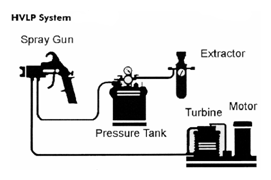
- You must apply coatings with a high volume, low pressure (HVLP) spray gun, electrostatic application, airless spray gun, or air-assisted airless spray gun. You may use an equivalent technology that is demonstrated by the spray gun manufacturer to achieve transfer efficiency comparable to one of the spray gun technologies listed above, and for which written approval has been obtained from the Administrator (EPA).
- All spray-applied coatings must be applied in a preparation station or spray booth. Prep stations and spray booths must be fully enclosed with a full roof and four complete walls or complete side curtains. They must be ventilated at negative pressure so that air is drawn into any openings in the booth walls or prep station curtains.
- The exhaust from the prep station or spray booth must be fitted with filters demonstrated to achieve at least 98 percent filter efficiency of paint overspray.
- Spray guns are to be cleaned in an enclosed spray gun cleaner or by cleaning the disassembled gun parts by hand. No spray gun cleaning is to be performed by spraying solvent through the gun, creating an atomized mist.
Training:
- All painters that spray-apply coatings must certify that they have completed training in techniques to minimize paint overspray.
- All spray painters at new sources must complete training no later than 180 days after hiring, or by July 7, 2008, whichever is later.
- All spray painters at existing sources must complete training no later than 180 days after hiring, or by January 9, 2011, whichever is later.
- Initial painter training will be valid for a period of five years. Painters that completed training in the last five years before the compliance date will be able to use that training to satisfy the initial requirement. These painters must still renew training within five years of the initial training date. Initial training is not required if documentation or certification demonstrates that a painter’s work experience and/or training has resulted in equivalent training.
- Refresher training must be repeated at least once every five years.
- Initial and refresher training must address the following topics to reduce coating
overspray and emissions:
- spray gun equipment selection, set up, and operation, including measuring coating viscosity, selecting the proper fluid tip or nozzle, and achieving the proper spray pattern, air pressure and volume, and fluid delivery rate;
- spray technique for different types of coatings to improve transfer efficiency and minimize coating usage and overspray, including maintaining the correct spray gun distance and angle to the part, using proper banding and overlap, and reducing lead and lag spraying at the beginning and end of each stroke;
- routine spray booth and filter maintenance, including filter selection and installation; and
- environmental compliance with the requirements of this subpart.





County Services